18 Feb 2026

- New extended areas across AlUla make the ancient oasis the world's third-largest Dark Sky Park.
- As Ramadan approaches, this certification echoes AlUla's past as a region for moon sightings.
- Independent measurements place AlUla's night skies in the top 5% globally for natural darkness and sky quality.
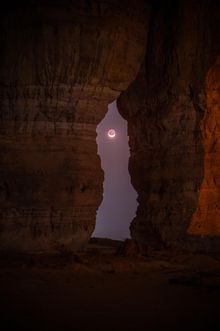
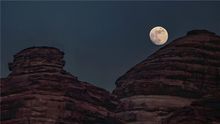
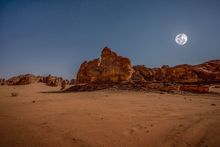
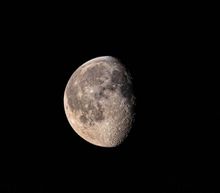
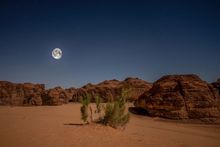
AlUla, Saudi Arabia – 18 February 2026: For generations, AlUla's clear skies have played a meaningful role in marking the start of Ramadan, when locals would look to the horizon to sight the new moon and confirm the Holy Month. Today, that same clarity underpins AlUla's evolution into a globally recognised astrotourism destination, now certified as the world's third-largest Dark Sky Park by DarkSky International.
Following the newly awarded Dark Sky Park designations for Sharaan National Park and Wadi Nakhlah Nature Reserve by DarkSky International (DSI), AlUla's certified dark-sky area has expanded to 6,146 km². Together with the previously accredited AlUla Manara site and Gharameel Nature Reserve, this creates an extensive connected landscape for night-sky discovery.
This recognition is underpinned by AlUla's recently approved Astrotourism Policy, which sets strict lighting zones, curfews and compliance standards across the destination. Independent measurements taken as part of the certification process place AlUla's night skies in the top 5% globally for natural darkness and sky quality, a level of clarity increasingly rare in the modern world.
This achievement echoes AlUla's legacy as a natural observatory, particularly on the cusp of Ramadan. Long before modern certification, celestial observation formed an essential part of AlUla's cultural heritage. The community's designated 'Moon Sighter' would fill a copper vessel with water and climb to an elevated vantage point.
Location was critical – the site required a clear western horizon, free from cosmic dust, urban pollution or natural obstruction. Local oral accounts suggest locations may have included AlMadhbah Fort, east of AlUla, and Harrat 'Uwayrid, west of AlUla.
Here the Moon Sighter would observe the reflections of the sun and moon's movement on the water, before confirming it with a palm frond formed into a circle where the crescent reflected. A telegram was sent to the court in Riyadh, contributing to the official statement declaring the start of Ramadan.
Majid AlZhoufi, AlUla Moon Sighter, said, “When you raise your head to the night sky and see it studded with stars, know for certain that you are in AlUla. This dreamy destination's sky is distinguished by its unparalleled clarity. You have no choice but to indulge in its beauty – observing it, contemplating it, and immersing in the Arab heritage of stories, poems and legends written across the skies. Muslims have long looked to the sun for prayer times, and the moon marks new months and the arrival of Ramadan. AlUla's renown as an astronomical beacon was and will remain an extension of our ancient heritage.”
Today, that tradition of celestial observation has evolved from necessity to experience. This legacy takes on new dimensions in the modern day, with AlUla offering a diverse roster of celestial-related experiences aligned with the global shift toward nature-based, low-impact and slow travel. Travellers are increasingly seeking destinations where darkness is not lost to urban glow but preserved as part of the landscape itself.
At a time when light pollution has increased by nearly 50% globally over the past two decades, truly dark skies are becoming increasingly rare. AlUla's tourism development has been intentionally guided by environmental thresholds and lighting controls that protect the very darkness visitors come to experience, ensuring that growth does not compromise the clarity of its night skies.
Phillip Jones, Chief Tourism Officer at the Royal Commission for AlUla (RCU), said: “AlUla's night sky is unlike anything most travellers have experienced before, so being recognised as the world's third-largest Dark Sky Park is a promise to visitors that this sense of wonder will be protected for years to come. As Ramadan approaches and families gather to reconnect, we welcome everyone to enjoy the peace and spirituality of AlUla during the Holy Month.”
For most visitors to AlUla during Ramadan and beyond, looking up at the sky turns into a transformative experience. On clear nights and across multiple viewing points in the destination, the Milky Way can be seen stretching in a bright ribbon across the sky, alongside sharply defined constellations and shooting stars visible with the naked eye.
Across its desert and oasis landscapes, AlUla offers guided stargazing in protected zones, specialist astrophotography sessions, wellness experiences under the stars, and curated celestial event viewings, including annual meteor showers and planetary alignments.
Set against dramatic sandstone canyons, ancient rock formations and millennia-old heritage sites, these experiences take place in carefully preserved locations guided by experts and aligned with dark-sky protection standards.
Dan Oakley, Policy and Destination Senior Manager at DarkSky International, said: “AlUla demonstrates how destinations can balance history and conservation with access. The scale of its protected night-sky area, coupled with a strong commitment to visitor programming and robust lighting policy, makes AlUla a standout example globally. We look forward to supporting AlUla as they deepen protection while growing sustainable astro-tourism that benefits communities and enhances the visitor experience.”
AlUla's certified darkness, protected terrain primed for outdoor photography and exploration and curated night-time programming offer a rare combination of exceptional celestial visibility and responsible access, creating an elevated tourism experience that sets the destination apart.
Together, this history and milestone align with Saudi Arabia's Vision 2030 priorities for environmental stewardship, scientific advancement and diversified responsible tourism, reinforcing AlUla's reputation as a global leader in conservation-led destination development.
Visit experiencealula.com to learn more.
ENDS
Notes to the Editor:
For further information, please contact:
Multimedia gallery:
High-resolution photos can be found here.
Ramadan Astrotourism Activities
- Memories of Ramadan Night Tour: Wander through AlUla's Old Town on a torchlit tour with a local Rawi narrating the rich traditions of Ramadan. Learn more.
- A Magical Journey Among the Stars: Enjoy a desert outing under a starry sky while learning about the wonders of astronomy. Learn more.
- Picnic Under the Stars: Let yourself be wowed by AlUla's star show as you enjoy a delicious picnic feast. Learn more.
- Stargazing at Gharameel: Experience the enchantment of desert, surrounded by Gharameel's mystical rock formations, and enjoy dinner alfresco. Learn more.
- y-Ursae Minorid meteor shower: On 19 February, revel in AlUla's clear skies to witness a stunning meteor shower with expert-led community viewing events. Stay up to date here.
Global Research
Over the past two decades light pollution has increased by at least 49% globally, and an estimated 99% of the continental United States and Europe live under light-polluted skies[1] highlighting the importance of sustainable lighting. Studies have also shown there is growing economic value of protected night skies, with dark-sky visitors contributing significantly to local economies in destinations that safeguard natural darkness. AlUla is positioning itself at the forefront of this global shift.
[1] https://extension.usu.edu/gnar/files/EconomicsOfDarkSkiesBrief_3-30-22.pdf
RCU Astrotourism Policy
RCU recently issued the Astrotourism Policy to combat light pollution and preserve AlUla's celestial heritage for generations to come. This framework, under the stewardship of AlUla Manara, defines stringent lighting controls, zoning, curfews and regulations for astrotourism activities.
Naif AlMalik, Wildlife & Natural Heritage Vice President at the Royal Commission for AlUla added: “Dark-sky protection, community, and sustainability are closely integrated with AlUla's long-term destination vision and enshrined in the Astrotourism Policy. Through AlUla Manara, we are turning to our skies for learning, exploration and connection. With the addition of Sharaan National Park and Wadi Nakhlah Nature Reserve, we will continue to invest in protection and programming alongside AlUla Manara-linked educational initiatives that bring science and culture together for residents and visitors.”
About AlUla:
Located 1,100 km from Riyadh, in North-West Saudi Arabia, AlUla is a place of extraordinary natural and human heritage. The vast area, covering 22,561km², includes a lush oasis valley, towering sandstone mountains and ancient cultural heritage sites dating back thousands of years to when the Lihyan and Nabataean kingdoms reigned.
The most well-known and recognised site in AlUla is Hegra, Saudi Arabia's first UNESCO World Heritage Site. A 52-hectare ancient city, Hegra was the principal southern city of the Nabataean Kingdom and is comprised of over 140 well-preserved tombs, many with elaborate facades cut out of the sandstone outcrops surrounding the walled urban settlement.
Current research also suggests Hegra was the most southern outpost of the Roman Empire after the Roman's conquered the Nabataeans in 106 CE.
In addition to Hegra, AlUla is also home to ancient Dadan, the capital of the Dadan and Lihyan Kingdoms and considered to be one of the most developed 1st millennium BCE cities of the Arabian Peninsula, and Jabal Ikmah, an open air library of hundreds of inscriptions and writings in many different languages, which has been recently listed on the UNESCO's memory of the World Register. Also AlUla Old Town Village, a labyrinth of more than 900 mudbrick homes developed from at least the 12th century, which has been selected as one of the World's Best Tourism Villages in 2022 by the UNWTO.
About DarkSky International:
Founded in 1988, DarkSky International works to preserve and protect the night-time environment and our heritage of dark skies through environmentally responsible outdoor lighting.
About the International Dark Sky Places Program:
Established in 2001, the program encourages parks, reserves, and communities worldwide to adopt effective lighting policies and education initiatives to safeguard the night. Over 220 places have earned certification, joining a global movement to reduce light pollution and protect access to the natural night sky.
For more information, please visit: experiencealula.com
[1] https://extension.usu.edu/gnar/files/EconomicsOfDarkSkiesBrief_3-30-22.pdf