 02 Aug 2004

GUAM - THE GATEWAY TO MICRONESIA FACTS AT A GLANCE
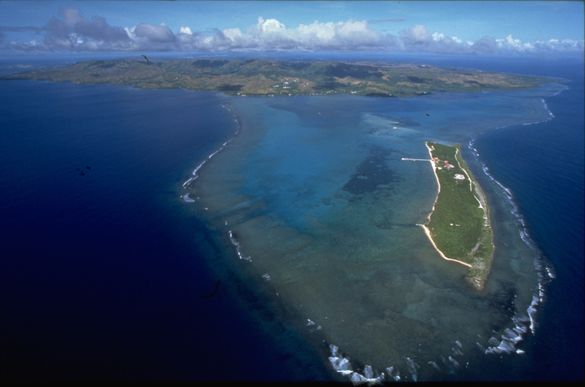
THE ISLAND Guam, an island territory of the United States, is located 900 miles north of the equator in the Western Pacific. From four to eight miles in width and 32 miles long, Guam covers approximately 212 square miles -- the largest island in Micronesia and the gateway to the region. It is approximately 6,000 miles from San Francisco, 3,800 miles west of Honolulu and 1,500 miles south of Japan.
The southernmost of the Mariana Islands, Guam shares a common culture with the rest of the group, which also includes Saipan, Rota and Tinian. The island was created from the peaks of two ancient volcanoes that sank into the sea and were fused together millions of years ago.
POPULATION The population of Guam is about 164,000 and can be divided into three primary ethnic groups. Chamorros, Guam�s original inhabitants, make up approximately 37 percent of the population, Filipinos 26 percent, and Caucasians (including military personnel and families) 10 percent. Korean, Japanese, Chinese and other comprise 27 percent of Guam�s population. Children between the ages of 1 and 14 make up 35 percent of the population; 58 percent are adults from 15 to 64; and 6.5 percent are people aged 65 and over. The population growth rate is 1.89 percent.
LANGUAGE English and Chamorro are the official languages, but Japanese and Filipino are also widely spoken.
CLIMATE Located in the tropics, Guam's average yearly temperature is 81 degrees Fahrenheit. The temperature rarely falls below 70 degrees or rises above 90 degrees. The average water temperature is 85 degrees, providing excellent opportunities for a variety of water sports. October through December is the rainy season and January through May the dry season. The average rainfall on Guam is approximately 80 inches.
ATTRACTIONS Guam's attractions range from tropical beaches and waterfalls to historic monuments and museums. Petroglyphs (cave paintings) and latte stones (pillars which supported ancient buildings and houses) provide insight into the lives of the ancient Chamorro people. Spanish ruins and World War II memorials are reminders of more recent events.
Sports enthusiasts enjoy world-class scuba diving to explore coral reefs and underwater wrecks, as well as snorkeling, windsurfing and swimming. Golf is available on courses designed by the legends of professional golf. Nature lovers can embark on one of the island�s many hiking trails to spectacular waterfalls, secluded beaches and World War II historical sites. Much of the island's history is embodied within two major attractions, the Guam Museum in Hagatna and the War in the Pacific Historical Park in Asan.
Guam�s traditional fiestas � village-wide celebrations introduced by the Spanish in 1668 and held every year since then by the island�s Chamorro people � often allow visitors the opportunity to experience the traditions and lifestyle of Guam�s indigenous people. The island custom is to welcome those who visit the village to join in the festivities.
HISTORY The first inhabitants of Guam, the Chamorro people, are thought to have traveled to the Mariana Islands from Southeast Asia by canoe. They developed a clan and caste system as part of a matrilineal society and they lived isolated from the rest of the world.
Ferdinand Magellan was the first westerner to set foot on Guam in 1521. Nearly 50 years later Spain claimed the Marianas and controlled them for more than 300 years. Jesuit missionaries brought Catholicism and a western way of life to the island. Because of its location between the Philippines and Mexico, Guam became an important link in the Spanish empire and its culture, with the church as the center of village life.
A new era began in 1898, when the island became a U.S. territory after the Spanish-American War. In 1899, the United States formally purchased Guam and other Spanish territories for $20 million.
Japanese forces invaded in 1941 and assumed control of the island until July 1944, when U.S. troops reclaimed it.
The Organic Act, signed by President Truman in 1949, made Guam an unincorporated territory and its people American citizens, as they remain today.
GETTING THERE The Antonio B. Won Pat International Air Terminal is served by Continental Airline from North American cities via Hawaii. Guam can also be reached via Manila, Tokyo, Osaka, Seoul, Taipei or other Asian gateways on Northwest Airlines, Phillippine Airlines, Japan Airlines, All Nippon Airways, China Airlines and Korean Air. Travel time from the West Coast via Honolulu is approximately 14 hours. ACCOMMODATIONS Guam has an array of accommodations including luxury resorts, business hotels, family-style accommodations and a bed and breakfast inn. Hilton, Westin, Hyatt Regency, Outrigger, Marriott, Nikko, Pacific Islands Club (PIC), Hotel Okura, Pacific Star, and other national and regional hotel chains have beach-front properties on the island.
TRAVEL DOCUMENTS Although U.S. citizens do not need a passport to visit Guam, proof of citizenship, such as a birth certificate, is required. Canadian citizens should carry their passports.
HEALTH No vaccination certificates are required.
TIME Guam is 18 hours ahead of Pacific Time.
ELECTRICITY The electrical current is the same as on the U.S. mainland: 120 volts/60 cycles.
CURRENCY The U.S. dollar.
For more information, visit www.visitguam.org.
# # #
For media information, contact: Dianne Newton-Shaw Guam Visitors Bureau (800) 873-4826 (9 a.m. - 5 p.m. PT) di@avisoinc.com