 04 May 2016

After 500 years of the German Beer Law, what's next?
Heidelberg, May 2016 –
Few beer lovers realise just how important Heidelberg once was as a centre of brewing expertise. Although most of the 36 breweries that used to be here closed by 1900, there are still four breweries that quench the thirst of happy Heidelbergers. A quick look behind the scenes at the Sudhaus makes one thing very clear: these breweries are much more than just businesses. Back in 1516, the German Purity Law allowed brewers to use only water, malted barley and hops to make beer (yeast came later). But all four breweries love to experiment, creating new, individual brews. “Tradition meets Innovation!” is their motto.
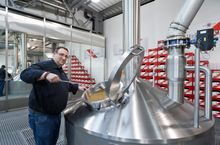
The Heidelberger Brauerei: Craft beer meets state of the art technology
It's a source of pride for managing director Michael Mack, “that the brewery has been an important part of such a historic town for 263 years”. For generations, the brewery has worked closely with local restaurants and pubs – especially the “Zum Roten Ochsen”, the historic student pub. 500 years old, the German Purity Law is the oldest known legislation focusing on food and drink quality. The Heidelberger Brauerei has followed this law for nearly three centuries. And Mack insists on sourcing all the ingredients (the barley, hops and water) locally. Using state of the art technology, his brewery sets a benchmark for the whole of Europe, guaranteeing the high quality and purity of their 21 different beers. There are also two special craft beers that have been created by Lutz Wirsching, the master brewer. The Urmensch-Bier (prehistoric man beer), is a homage to Homo heidelbergensis; a Jubilee beer marks 1,000 years of the nearby Bammental valley with its prehistoric finds. For 2017, a Lutherbier has already been requested to celebrate the 500th anniversary of the Reformation.
Kulturbrauerei Heidelberg: Daring to be different
Over the course of the 18th and 19th centuries, successive generations of the Schaaf Family brewed beer within the walls of the historic Kulturbrauerei. Today, barley is still malted and beer is still brewed for the Zum Zeppl pub. In the old days, the beer was transported through an underground passageway from the cellar to the pub – a meeting point for students that is as popular today as it was back then. Master Brewer Thomas Lamerz uses only the finest quality ingredients for the beers he serves in this historic and atmospheric setting. Each beer has its own unique flavour, thanks to the use of specially imported hops from Australia, America and New Zealand. The result is beers with the aroma of exotic fruits, such as lychee, pineapple, pine, orange, grapefruit and passion fruit. And all this is done staying within the boundaries required by the German Purity Law which still sets the standard for the Kulturbrauerei. Jürgen Merz, the managing director, is quite clear on this: “If brewers don't follow the rules laid out in this law, then you simply can't call it beer”.
Vetter's Alt Heidelberg Brauhaus: “It's the mix that matters!”
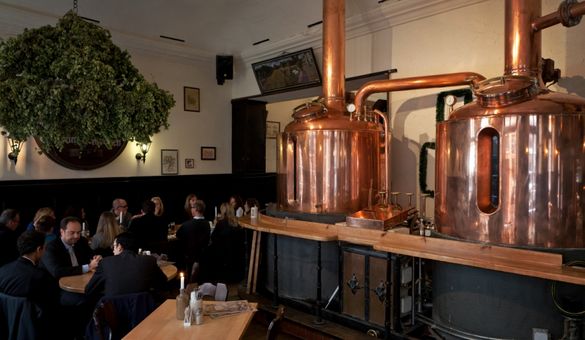
The party for Brauhaus Vetter's 30th birthday next year is already being planned. 10 different beers are on offer in Heidelberg's first brewpub. Brewed using locally-sourced ingredients in two large kettles located in the drinking and dining area of the pub, the beer is only served and sold on the premises. One of the beers became particularly famous in 1994: using 33% original wort, the “Vetter 33” brew made it into the Guinness Book of Records as the strongest beer in the world to be brewed following the guidelines of the German Purity Law. “We produce craft beers and tradition dictates that we follow the letter of the Purity Law” is the view of the director, Michael Vetter. “There are more than 5,000 different beers in Germany, all made with the same basic ingredients. Nevertheless, they all taste different and the smaller breweries in particular are adding diversity and variety. This is achieved by roasting the malt in different ways and using the individual ingredients in different proportions. It's rather like letting tea brew for different lengths of time”. However, Vetter also accepts that the customers are happy if the flavour is enhanced by adding ingredients falling outside the strict guidelines of the purity law. But then you can't call it beer, he says: “In the same way that a vegetarian sausage is not really a sausage”.
Brauerei zum Klosterhof Heidelberg: The joy of experimenting – within or without the Purity Law
For the Kloster Brewery, the secret of the smooth, mild flavour of their beer is the natural spring water that comes straight from the nearby hills. No wonder locals have been enjoying it for generations. As you'd expect from an organic brewery, all the ingredients are locally sourced from organic farmers to ensure the lightest of carbon footprints. There are six types of beer in the standard range: in addition to five seasonal beers, the brewery offers unusual specialist products such as "Siegelbier" which is matured in small oak barrels that have held sherry, brandy or whisky. Working this way, Till Barucco, the managing director's assistant, sometimes feels the need to stray from the strict rules imposed by the Purity Law because "it also forbids the use of natural products like orange peel". Luckily for this organic brewery, labelling their products in a particular way (not as beer!) allows them to experiment to their hearts' content. They're already planning to brew an ale using orange peel and the beer world is licking its lips in anticipation of the promise of "more audacious experiments with different varieties of hops and malt." On a more conciliatory note, Barucco is keen to stress that the purity law is "a great thing which protects us all".
Further information about the breweries, on beer seminars and brewery tours at:
http://www.heidelberg-marketing.de/en/experience/art-of-brewing.html
Reproduction free of charge – please provide a copy for our records.
Image material for downloading:
https://ww2.heidelberg.de/owncloud/index.php/s/g3Xnmx0VT4b93LF