 28 Oct 2022

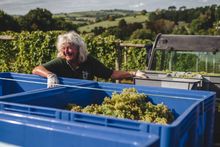
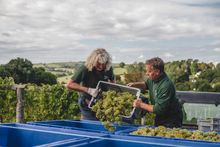
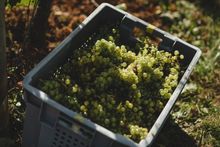
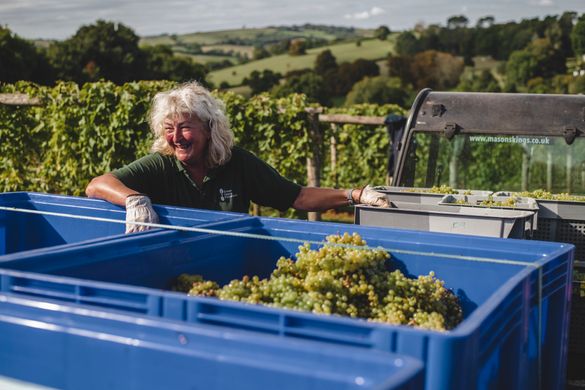
Sandridge Barton, the home of Sharpham Wine, is toasting a bumper harvest. With the help of paid workers and community volunteers, more than 80 tonnes of grapes – enough for approximately 80,000 bottles – have been picked over a four-week period.
It's been a momentous year for the Devon-based wine producer, its new visitor centre, winery and restaurant situated in the countryside on the east bank of the River Dart launched in June. Since then, the estate has gone from strength to strength, welcoming visitors for tours and tastings, stunning food at the on-site restaurant Circa and overnight stays at the gorgeous self-catering accommodation.
On top of all that, the vineyard has now had a bumper harvest of grapes. Duncan Schwab, CEO and Head Winemaker at Sandridge Barton, says it is going to be “one of the best vintages to date. The grapes have a great fruit intensity, high sugars and balanced acidity.”
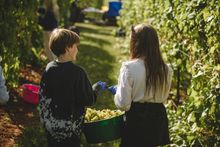
The estate invited community volunteers to take part in two days of picking this year, on 24 September and 15 October. Around 80 volunteers joined in the fun, with people of all ages, including individuals, couples and families all getting involved. Fantastic weather on both days made the event even more enjoyable.
After all of their hard work, the volunteers were treated to a barbecue and a glass (or two!) of wine and took home a bottle at the end of the day for their efforts.
Duncan commented on the year so far, “The number of visitors is growing following our move over the river from the original Sharpham Wine site. Feedback on our new home has been incredible, with tours and tastings taking place in beautiful surroundings and buildings.
“The weather over the summer certainly helped attract visitors with our south-facing courtyard proving a real success. Another huge hit is our new restaurant, Circa, which has wowed customers with its stunning menus featuring foraged food and produce from the estate, as well as fish and seafood from nearby Brixham Fish Market.”
Vines were first planted at Sandridge Barton in 2008. Pinot Noir, Bacchus, Chardonnay, Madeleine Angevine and Pinot Gris are now grown in the vineyards which spread across 32 acres of the 450-acre estate. The Sandridge Barton estate is positioned just south of the village of Stoke Gabriel, which is a few miles upriver from the ever-popular town of Dartmouth and a few miles downriver from Totnes. Rich in history, most of the land falls into the South Hams AONB.
A vineyard called Stony Field, which is on a limestone ridge, was recently planted. Some of the premier wine districts in the world are planted on limestone and this, coupled with the increase in popularity of English wines, sets an exciting future for the bottles produced at Sandridge Barton.
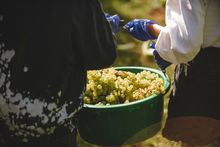
On 24 September, the enthusiastic and willing community volunteers were busy picking four tonnes of Madeleine Angevine. A white grape variety which grows well in cooler climates and can be eaten as well made into wines, which are typically light, dry and crisp with pleasant acidity.
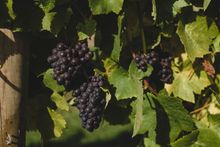
On 15 October, it was onto Pinot Noir for the community harvest, with six tonnes picked in a day. Pinot Noir is a red grape that also thrives in cooler climates and is one of the three main varieties used to make Champagne and English Sparkling wine (along with Chardonnay and Pinot Meunier).
There's so much to experience at Sandridge Barton estate. Enjoy wine and cheese tastings and tours, from casual self-guided options to in-depth guided tastings where you'll learn about the processes used in the vineyard and winery.
Discover the exciting menu packed with world-class local produce at Circa at Sandridge Barton restaurant, open Thursday-Monday 10am-4pm, and Friday evenings 6pm-9pm.
Extend your visit and stay at Sandridge Barton's self-catering accommodation in three unique properties. The 12-person Sandridge Barton House is perfect for larger groups, the secluded four-person Boathouse is ideal for rural retreats, and the newly-renovated six-person Lower Well Farmhouse is available for those who want to be close to the action.
To find out more please visit sandridgebarton.com and to stay up to date 'like' or 'follow' Sandridge Barton Wines on Facebook, 'follow' @sandridge_barton on Instagram and @SharphamWines on Twitter.
- ENDS -
A selection of images and a video can be found here.
For further information, or to request an interview with Duncan Schwab please contact:
Hanna China, RAW Food and Drink PR, Mobile: 07702 031 956
Hanna@rawfoodanddrinkpr.co.uk
Notes to editors
- Bookings for vineyard tours, wine tastings, the on-site restaurant and self-catering accommodation can be made on sandridgebarton.com. For wine, cheese, vouchers and gifts, visit the online shop: shop.sandridgebarton.com/collections.
- Sharpham Wine maintained one of Britain's oldest vineyards, planted in 1981 on the Sharpham Estate on the west bank of the River Dart close to Sandridge Barton. Once the nearby vineyard was established, grapes from there were supplied to Sharpham Wine, which has now moved downriver to its new home.
- Sandridge Barton makes several different wines with Madeleine Angevine: its most popular wine, Dart Valley Reserve 2021 (£15); the Sharpham Estate Selection 2021 (£17.20) and Sharpham 'Figgie Daniel' Col Fondo 2021 (£22).
- Some of the Pinot Noir grapes are made into Sharpham Sparkling Reserve (£35) and Sharpham Sparkling Pink (£30), both traditional method sparkling wines. There's also the Pinot Noir Rosé 2021 (£16.50) and Sharpham Pinot Noir 2021 (£22).
- The Sandridge Barton estate operates as a small mixed farm with arable, pasture (for a prize herd of South Devon cattle), orchards and vineyards. It has a diverse landscape with extensive woodland, streams, ponds and abandoned quarries. Lower Well Farm forms part of the estate and was until recently a run-down dairy farm before its rejuvenation by the construction of the winery and the conversion of traditional barns into the winery visitor centre.
- Sharpham cheeses will continue to be made on the Sharpham Estate and will be sold through the shop at Lower Well Farm, which will continue the Sharpham brand. The dairy produces a range of cow and goat milk cheese to national and international acclaim. With milk from the herd of Jersey cows, plus goat and sheep milk from its neighbours, it produces handmade cheeses full of character and flavour which reflect this part of Devon.
- Iron age and Roman remains have been found on the Sandridge Barton estate. In c1543, it was the birthplace of the Elizabethan navigator and explorer John Davis, mapper of the Davis Straits between Greenland and Labrador, and discoverer of the Falkland Islands. An image of his ship, the Desire, is on the Falkland's coat of arms. He grew up at Sandridge Barton and owned it until he was killed in 1605 by Japanese pirates on the coast of Malacca in the East Indies. His childhood neighbours and lifelong friends were the explorers Humphrey Gilbert (who founded the colony of Newfoundland) and Adrian Gilbert, and their half-brother, Walter Raleigh. He was the foremost navigator of his time, and apart from the maps and records he left including his three attempts to find the Northwest Passage, his voyage to the South Atlantic and four voyages to the East Indies, he wrote two scientific books on navigation, invented the Davis backstaff that was used in navigation for 200 years, and developed the model for ships' log books.
- In more modern times, US forces were stationed at Sandridge Barton during WWII pending their departure for Normandy. There are signs of their presence, including carvings on beech trees in the woods along the River Dart. The woods also contain the remains of an Auxiliary Unit Operations Base from WWII, a secret auxiliary army unit mostly made up of local gamekeepers and farmers who knew the land and who were to engage in irregular warfare in the event of an invasion by Nazi Germany. From the invasion, there was a projected life expectancy of 12 days.