 14 Feb 2015

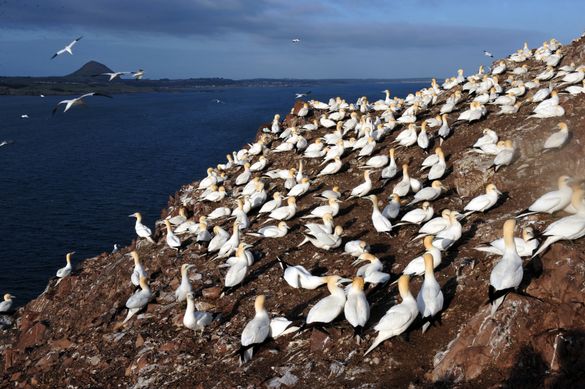
The Scottish Seabird Centre, East Lothian, announces that a count of Northern gannets undertaken by Stuart Murray, in conjunction with the Centre for Ecology & Hydrology (CEH), has shown that the Bass Rock is now the world's largest colony.
The Bass Rock is located 4km (2.5m) from North Berwick and the Northern gannet's scientific name (Morus bassanus) is derived from the Bass itself.
In 2014, independent counts made by Stuart Murray and Mike Harris (CEH), with advice from Maggie Sheddan, the senior Bass Rock guide for the Scottish Seabird Centre, found 75,000 apparently occupied sites (AOS). This is an increase of 24% since a similar count made by Stuart Murray in 2009.
Stuart Murray said: "The colony was photographed from the air on 23 June 2014. Conditions were excellent, with no wind and a high cover of thick cloud which obscured the sun, reducing the glare from all these startlingly white birds. The images were later viewed on computer screens for counting and each occupied site was blocked-out as it was counted.
"Interestingly, the most dramatic increase is between the old lighthouse keepers' garden and the summit of the Rock. We counted around 10,000 sites in this area compared with 6,500 five years ago."
Sarah Wanless, from the Centre for Ecology & Hydrology, said: "Our long-term research on North Sea seabirds aims to understand how species such as the gannet will cope with the rapid pace of environmental change. This is our fifth census of the Bass Rock in the last 30 years.
“It is particularly heartening to see them doing so well when so many other seabirds in Scotland appear to be in trouble, however, the Bass Rock is a small island and the gannets have now filled most of the available nesting habitat. The colony now has only very limited capacity for further increase.”
Tom Brock OBE, Chief Executive of the Scottish Seabird Centre, said: "Scotland is of international importance for seabirds and is home to over 60% of the world's population of Northern gannets. The figure of 75,000 sites is phenomenal especially when many apparently occupied sites will represent a breeding pair and their chick. I would expect that the total gannet population on the Bass in the breeding season will be well in excess of 150,000 birds. Every year the Bass Rock turns brilliant white with the sheer number of gannets crammed onto the Rock and not, as some people think, with their guano.
"While this is fantastic news we cannot ignore the fact that although gannet colonies are currently thriving other seabird species are not. This is a very complex issue however we know that gannets are able to travel further to forage for food - even as far as the coast of Norway.
"Many seabirds are now under threat and as a conservation and education charity we will continue to work in partnership with other organisations across Scotland to undertake further research and appropriate action, where we can, to conserve Scotland's amazing wildlife for future generations."
Visitors to the Scottish Seabird Centre can control the interactive live cameras and zoom in on the live gannet action on the Bass Rock. The gannets will start to return any day now and will stay until October. The Seabird Centre's boat trips to the Bass Rock will start at Easter.
Gannet facts:
- First records of gannets on the Bass Rock date back to the 15th century
- Gannets are Britain's largest seabird, with a wing span of over 6ft/ 1.8m
- Gannets travel south for the winter, many travelling as far as the coast of West Africa
- They can live over 30 years
- They have excellent eyesight and can spot schools of fish below the surface of the water and dive at speeds of up to 60mph/ 96kmph.
Bass Rock facts:
- The Bass Rock was formed 320 million years ago and is the core of an old volcano
- It has played a key role throughout Scottish history – a religious retreat during early Christianity; fortress and prison in the time of the Covenanters and Jacobites; and a strategic stronghold during the times of the Scottish and English wars
- It has been owned by the Hamilton-Dalrymple family for the last 300 years
- There is a lighthouse, built in 1902: the last keepers left in 1988 when the lighthouse was automated.
For further information visit www.seabird.org