13 Mar 2026

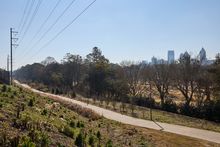
The Atlanta Beltline Arboretum stands as the world's longest linear arboretum, spanning 12.44-miles of completed trail. Connecting more than 45 neighborhoods adjacent to the Beltline, it serves as a continuous educational and environmental resource enjoyed by millions of visitors each year. The arboretum continues to grow, reaching 16.7 miles of trail by summer 2026, and progresses toward completion of the full 22-mile loop by 2030. It maintains Level II accreditation from ArbNet, an international network of more than 900 arboreta.
This milestone adds to Atlanta's growing list of world-class distinctions, including the world's busiest airport, the largest aquarium in the United States and now the world's longest linear arboretum—a free, gateless public garden—further establishing the city as a global destination as it prepares to host FIFA World Cup 2026™ matches. More than 16 miles of continuous mainline trail will be complete by the time Atlanta hosts FIFA World Cup 26™ matches in Atlanta later this year.
This new designation as the world's longest arboretum recognizes two decades of partnership between Atlanta Beltline, Inc., and Trees Atlanta to plant the arboretum along each mile of the 22-mile rail-to-trail conversion from former rail lines into one of the largest redevelopment projects in the country. The Beltline is still under construction and currently more than 13 miles of trail is completed with the 22-mile loop to be completed by 2030. Along the way, hundreds of thousands of trees, grasses and shrubs have been planted along the trail to create a verdant corridor that highlights Atlanta's iconic tree canopy as part of a unique development of ecological services within an urban context.
“As we celebrate our 20th year and prepare to welcome FIFA World Cup 2026™ visitors with even more miles of trail, the arboretum highlights how urban redevelopment can showcase biodiversity and ecosystem restoration while catalyzing economic development, new affordable housing, and future mobility/transit infrastructure for generations,” said Clyde Higgs, President & CEO Atlanta Beltline, Inc. “We're proud that as we connect more than 45 neighborhoods, we're doing it not just with trails but also with an ecological corridor of native Georgia plants, creating an urban oasis where people can relax and see birds, butterflies, and other species attracted to this habitat.”
The 60-acre arboretum links directly to more than 400 acres of parks, 13.6 miles of mainline trail, and 11 miles of connector trails creating a growing network of connected greenspaces adjacent to the Beltline, often described as an “emerald necklace.” Together, this trail network expands access to nature and the benefits of trees in the heart of Atlanta for residents and trail users across more than 45 neighborhoods adjacent to the Beltline.
This connected network includes parks such as Historic Fourth Ward Park, Perkerson Park, Rose Circle Park, Shirley Clarke Franklin Park, Thomas Taylor Memorial Skatepark, Gordon White Park, D.H. Stanton Park, Boulevard Crossing Park, Enota Park, Piedmont Park, Arthur Langford, Jr. Park, and Adair Park.
Thanks to the partnership with Trees Atlanta, the Beltline Arboretum intentionally prioritizes sustainable landscape management practices focused on urban ecosystem restoration. The arboretum showcases both native and non-native species to demonstrate trees, shrubs, and plants that can grow in Georgia, including special collections such as a pitcher plant bog, native azaleas, and over 15 cultivars of pawpaw. A key component of a healthy ecosystem is diversity, and the Beltline Arboretum reflects this with more than 647 unique tree and woody shrub species and cultivars across 106 genera.
Trees Atlanta has also planted over 700,000 native plants, including grasses and wildflowers, along the corridor. Trees Atlanta is a key design and installation partner of the arboretum, creating a model emphasizing native selections that has influenced other Beltline properties.
Trees Atlanta's engagement on the Beltline also includes regular community projects that allow volunteers to help install plants in the arboretum meadows, maintain the planted spaces through events such as the popular Weeds & Wine program, and educate the public by leading regular free guided tree tours of the arboretum.
“Trees are iconic to Atlanta's identity, and Georgia is special in its incredible diversity of plants and trees. Before the Atlanta Beltline Arboretum was created, there was no other arboretum in the city of Atlanta,” said Greg Levine, executive director of Trees Atlanta. “We're proud that the Atlanta Beltline Arboretum is the world's longest linear arboretum and is free and accessible to millions of people. The Atlanta Beltline Arboretum is an important part of Atlanta's urban forest and brings attention to the benefits of trees for the health and well-being of people, wildlife, and the natural environment. Our 20-year collaboration has built a unique botanical garden that demonstrates how trees and greenspaces improve where we live.”
The arboretum features several art collections of interest, including 33 Oaks which shows Georgia's native oak species. Each of the species is planted on the Eastside Trail interspersed with a striking art installation of each tree's leaf shape in large polished stainless steel by Atlanta artist David Landis. This and four other art installations have been donated to the Beltline Arboretum by Trees Atlanta to inspire and support education.
The Beltline Arboretum first was accredited by ArbNet in 2016 and maintains a “Level II” status, which the organization uses to recognize institutions with significant plant collections and professional arboricultural capacity. ArbNet defines an arboretum as a living museum of trees and woody plants, grown and cared for by an organization committed to their stewardship.
“The Atlanta Beltline Arboretum is a uniquely shaped linear arboretum, acting as an essential oasis for people, plants, and wildlife within the Atlanta urban ecosystem,” said Andrea Brennan, ArbNet Manager at The Morton Arboretum. “ArbNet is proud to have this level II accredited arboretum within our international arboretum community. By meeting the tree planting and management, organizational, educational, conservation, and collaborative requirements of the ArbNet Arboretum Accreditation Program, the Atlanta Beltline Arboretum is demonstrating its strong commitment to trees and serving as a far-reaching, 22-mile-long community asset now and for the future.”
Guided, free walking tours of the Atlanta Beltline Arboretum are available through Trees Atlanta. Learn more here on upcoming tree tours. Trees Atlanta headquarters also is located on the Atlanta Beltline Southwest Trail. Its campus extends the design of the arboretum with plantings entirely of native species and landscape designed for natural stormwater management.
For more information about the Atlanta Beltline Arboretum visit here. Media assets are available here.