 27 Mar 2019

ANTONELLO DA MESSINA
Milan, Palazzo Reale
21 February – 2 June 2019
Like so many great artists, Antonello da Messina (1430-1479) left only a handful of extraordinary works that managed to escape tragic natural events like floods, earthquakes, seaquakes, and the neglect and ignorance of humans. His surviving works are dispersed in various collections and museums in Italy, Great Britain, and America; many have undergone heavy restorations that have permanently altered their original appearance, others have reached us miraculously intact. This exhibition, which will run from February 21 to June 2, 2019 at Palazzo Reale, Milan, is the result of cooperation between the Region of Sicily and the City of Milan. Produced by Palazzo Reale and MondoMostre Skira, it is one of the key cultural events of 2019, both nationally and internationally. A unique occasion to enter the world of the greatest portraitist of the 15th century, an outstanding painter who left a lasting imprint on Italian and European art.
Thanks to cooperation with numerous Italian and international institutions, nineteen works by Antonello da Messina will be on show for the first time ever in a historic exhibition that will give the general public a once-in-a-lifetime opportunity to explore the fascinating story of one of Europe's most crucial and innovative artists, still astonishing after so many centuries.
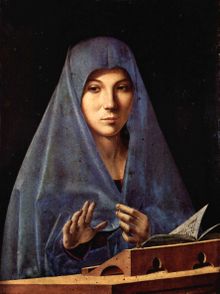
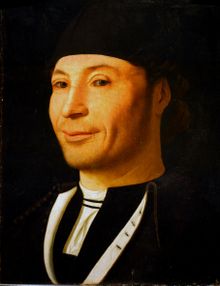
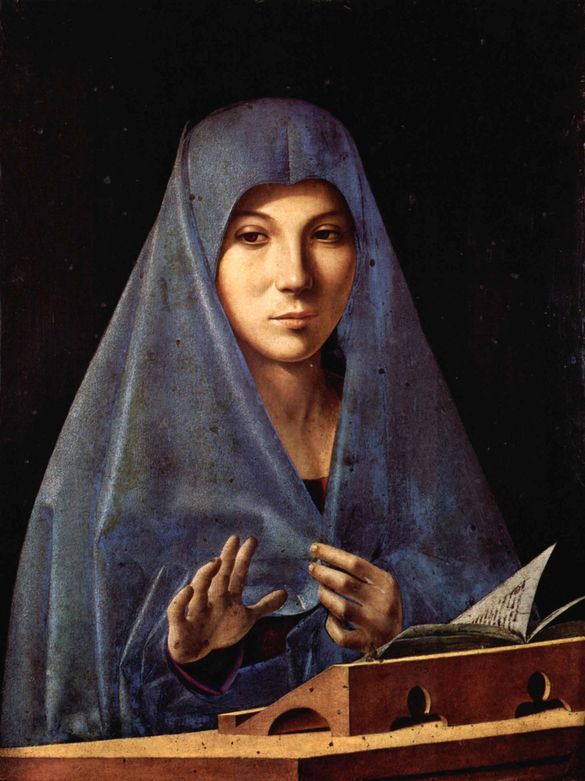
The exhibition will display nineteen of Antonello's thirty-five autograph works: they include the Annunciate (c. 1475), a true icon and the distillation of Antonello's art, one of the supreme masterpieces of the Quattrocento, with its highly moving portrayal of the Virgin, her gaze and gesture responding to a mysterious presence beyond the picture; the elegant figures of St. Augustine (1472-1473), St. Jerome (1472-1473) and St. Gregory (1470-1475), possibly part of a Polyptych of the Doctors of the Church (all from Palermo's Palazzo Abatellis); as well as the celebrated Portrait of a Man (1465-1476) with an enigmatic smile, traditionally referred to as the “Unknown Sailor”, that was originally used as a cupboard door and restored on several occasions (Fondazione Culturale Mandralisca in Cefalù).
Also on display is St Jerome in his Study (1474-1475), a painting mingling classic inspiration with Flemish details (National Gallery, London); the Crucifixion (c. 1460), a work first attributed to Antonello by Karl Voll in 1902 and then by Bernard Berenson in 1932 (Mezeul National Brukenthal, Romania); the Portrait of a Young Gentleman (1474) (Philadelphia Museum of Art);the enchanting Madonna and Child (c. 1475) (National Gallery of Washington), and the Portrait of a Young Man (1478) (Staatliche Museen, Berlin).
The exhibition will also include a major triptych with Madonna and Child, St John the Evangelist – acquired in 1996 by the Ministry of Cultural Heritage and Activities – and St Benedict, a work of superb pictorial quality from the Uffizi Gallery; as well as an early work long thought to be a self-portrait of the artist (Portrait of a Man; 1468-1470: Pinacoteca Malaspina in Pavia); typical of the Master in terms of its background, pose, and, above all, in the slightly ironic gaze of the sitter, it was stolen from the museum during the night between May 10-11, 1970 and recovered seven years later by the Art Theft Unit of the Carabinieri. Also on display is the celebrated Ecce Homo (1473-1476) from the Collegio degli Alberoni in Piacenza. Other notable works are the Portrait of a Man (Michele Vianello?) (1475-1476) from the Galleria Borghese, Rome; the moving Dead Christ Supported by Three Angels (c. 1474-1476) from the Museo Correr, Venice; and the Portrait of a Man (also known as the Trivulzio Portrait; 1476) from the Museo Civico d'Arte Antica, Palazzo Madama, Turin.
This section on the great Master ends with the lovely Madonna and Child (1480) from Bergamo's Accademia Carrara, painted by Antonello's son Jacobello di Antonello in the year after his father's death. In his unusual signature, a moving display of filial devotion, he describes himself as the son of a “painter who was not human”, in other words, divine. Jacobello, who was employed in his father's workshop, completed the works left unfinished at his father's death.
The next section seeks to reconstruct the history of the San Cassiano altarpiece, one of the cornerstones of Italian art. Also on display is a 19th-century work dedicated to the myth of Antonello; Roberto Venturi's Giovanni Bellini Spies on Antonello to Discover the Secrets of Oil Painting (1870: Pinacoteca di Brera) normally hangs in the Court of Milan and has been restored especially for this exhibition.
This exhibition has an exceptional guide in the great art historian Giovan Battista Cavalcaselle whose notebooks and drawings will offer visitors valuable insight into Antonello da Messina, asc one of the fathers of Western art. Thanks to an extraordinary collaboration with the Biblioteca Nazionale Marciana, Venice, the exhibition displays 19 wonderful drawings (7 notebooks and 12 sheets including folios) by Giovan Battista Cavalcaselle who was responsible for painstakingly reconstructing the first catalogue of Antonello's work.
The exhibition also focuses on the artist's relationship with his home town and the few documentary traces of the great Sicilian painter's life that have survived the many tragic natural events, earthquakes in particular. Following in Cavalcaselle's footsteps was a redoubtable scholar from Messina, Gaetano La Corte Cailler, who uncovered and transcribed notarial documents revealing details of the events in the life of the painter's family: his grandmother's will, the return of the painter's family from Calabria by brigantine, his daughter's dowry, and lastly Antonello's own will, dated February 1479. Nothing else remains of him: a flood washed away his bones in an old cemetery and a series of earthquakes destroyed various archives in Noto and in other Sicilian towns. Old Messina was destroyed and rebuilt in 1783 before being definitively devastated at 5.21 am, Monday 28 December, 1908 by a massive earthquake followed by a tsunami, which substantially wiped out the Sicilian city.
An exhibition of this scope and importance demands an equally unique book taking the form of an exhibition catalogue published by Skira with reproductions of all the surviving autograph works by Antonello da Messina; an art-historical section with essays by Giovanni Carlo Federico Villa, Renzo Villa, Gioacchino Barbera, and by five writers: Roberto Alajmo, Nicola Gardini, Jumpa Lahiri, Giorgio Montefoschi, and Elisabetta Rasy. The book is completed by a Biography and Annotated Bibliography.
A truly fascinating and unique exhibition that will allow visitors to admire the profound psychological introspection revealed by the faces of these quintessentially Italian men and women portrayed by the great artist, and the technical virtuosity of the multilayered applications of paint and pigment mixtures that Antonello learned from contemporary Flemish painters, adapting the technique and mingling it with Venetian influences to develop his own unmistakable and exquisitely beautiful Mediterranean manner of painting.